


A company may have every policy neatly filed. The payroll may run on time. Contractors may submit their documents every month. Registers may be available whenever somebody asks for them.
And yet, the organization may still have serious compliance gaps.
I have seen this happen for a simple reason: what is written, what is recorded and what actually happens at the workplace are not always the same.
A contractor submits a PF record, but nobody checks whether the names match the workers actually deployed at the plant. An overtime policy exists, but employees regularly work beyond normal hours without the practice being properly reviewed. An appointment letter says one thing while the employee’s actual role has evolved into something quite different.
This is where HR compliance needs to be understood differently.
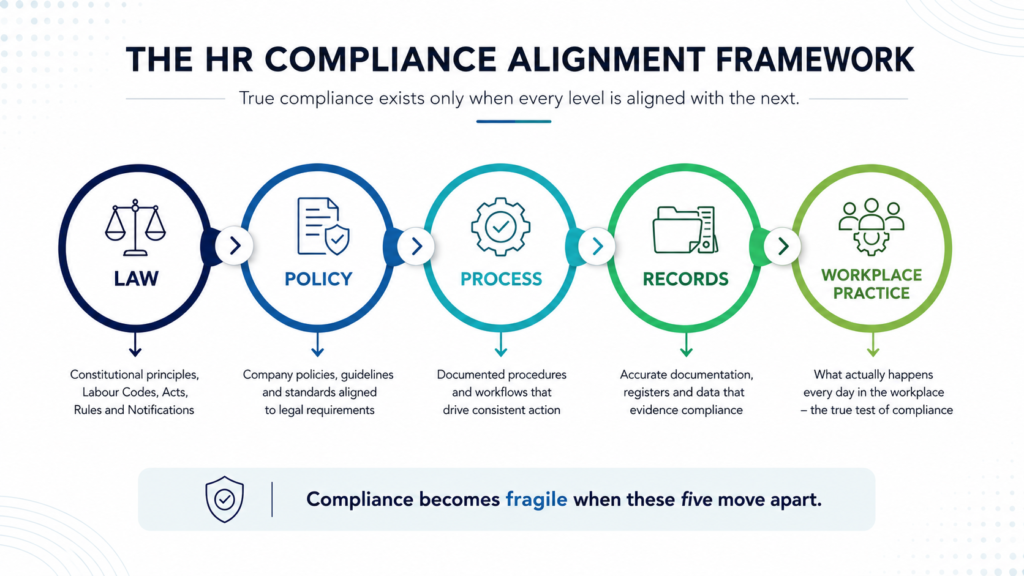
Compliance is not a collection of certificates kept ready for inspection. It is the discipline of keeping law, policy, process, records and workplace practice aligned.
For employers in India, that responsibility has become particularly important following the implementation of the four Labour Codes from 21 November 2025.
This HR compliance checklist for India is therefore not intended as another list of Acts and forms. It is a practical framework for HR leaders and employers to examine whether compliance is actually working inside their organization.
India’s Labour Law Framework Has Changed
India’s labour-law framework has undergone a major restructuring.
Twenty-nine Central labour laws were rationalised into four Labour Codes:
- The Code on Wages, 2019
- The Industrial Relations Code, 2020
- The Code on Social Security, 2020
- The Occupational Safety, Health and Working Conditions Code, 2020
The four Codes took effect from 21 November 2025. The Ministry of Labour & Employment has since issued compliance guidance, FAQs and rules/notifications dealing with their implementation.

The objective is not simply consolidation. The new framework also seeks to simplify registrations, licences, returns and records while moving more compliance processes towards electronic systems.
For HR professionals, however, simplification should not be confused with reduced responsibility.
There is another important point. Not every provision applies identically to every organization.
Applicability can depend on the nature of the establishment, number and category of employees or workers, industry, location, appropriate government, and Central or State rules and notifications.
An HR Head should therefore resist the temptation to download a generic statutory checklist and assume that it represents the organization’s complete compliance position.
The first question should always be:
What exactly is applicable to our establishment?
Only after answering that should the organization build its compliance calendar.
1. Start With an Applicability Map
Before checking compliance, check applicability.
HR should maintain an updated legal applicability register identifying at least:
- nature of establishment and industry;
- location of each establishment;
- workforce strength;
- employee and worker categories;
- number of contract workers;
- inter-State migrant workers, where applicable;
- relevant registrations and licences;
- appropriate government;
- applicable Central and State rules;
- statutory committees required;
- periodic returns;
- notices and displays;
- record-retention requirements;
- responsible internal owner for each compliance.
This sounds elementary, but it prevents a surprisingly common problem: organizations complying very well with requirements that they know about while completely overlooking one that actually applies.
Whenever the workforce changes significantly, a new unit opens, contract labour increases, operations expand to another State or a new process begins, the applicability register should be reviewed.
Compliance should follow the business. It should not wait for the business to discover it later.
2. Check Employment Documentation
One of the simplest questions HR can ask is:
If I pick the file of any employee today, can I reconstruct the employment relationship clearly?
The Occupational Safety, Health and Working Conditions framework requires appointment letters to employees. Beyond the statutory requirement, clear employment documentation is one of HR’s strongest preventive controls.
Review whether employee files contain, as applicable:
- appointment letter;
- designation and role;
- joining documentation;
- terms and conditions of employment;
- wage/salary structure;
- probation and confirmation records;
- transfers and promotions;
- nominations and declarations;
- attendance and leave records;
- disciplinary records, where relevant;
- separation documents.
A good appointment letter is not merely something given to an employee on joining and forgotten.
If an employee joined as an executive seven years ago but now performs a substantially different role, HR should ask whether the documentation still reflects reality.
That distinction can become important when questions later arise about service conditions, responsibilities, benefits or employee/worker classification.
3. Review Wages and Payroll Carefully
Payroll compliance is one area where small assumptions can create large liabilities.
Under the Code on Wages, minimum-wage protection applies broadly to employees, and the appropriate government continues to have an important role in fixing applicable minimum wages.
HR and payroll teams should check:
- applicable minimum wage rates;
- employee classification;
- wage period;
- timely payment of wages;
- authorized deductions;
- overtime;
- wage slips;
- bonus applicability;
- equal remuneration requirements;
- wage and attendance registers;
- changes in statutory wage notifications.
There is also a significant change around the definition of wages under the Labour Codes.
Employers should review salary structures rather than assuming that an old salary breakup remains appropriate under the new framework. The Ministry’s Labour Code FAQs confirm that the revised definition of wages became effective from 21 November 2025.
This is an area where HR, payroll, finance and the organization’s legal/compliance adviser should work together.
A payroll system can calculate exactly what it has been programmed to calculate.
That does not automatically mean the calculation is legally correct.
4. Match Attendance, Working Hours and Overtime With Reality
This is one of the areas where I would encourage HR professionals to move away from the desk and look at actual workplace practice.
Ask:
Does the attendance system reflect the hours employees actually work?
Are shift timings properly controlled?
Who authorizes overtime?
Does recorded overtime correspond with production records, access records or other available evidence?
Are weekly rest and leave requirements being followed?
Are employees informally staying beyond scheduled hours without those hours being recognised?
The Code on Wages provides for overtime at not less than twice the normal rate for covered employees whose minimum rate of wages is fixed under the Code, while working-hours and leave requirements also arise under the OSH framework and applicable rules.
The precise requirement can depend on the employee/worker category and applicable Central or State provisions.
The practical lesson is simpler:
Do not audit only the attendance register. Audit the working practice behind the register.
5. Check Social Security Compliance
Provident fund, ESI, gratuity, maternity benefits and employee compensation remain major areas of employer responsibility under the Code on Social Security framework.
Depending on applicability, HR should verify:
- establishment registration;
- eligible employee coverage;
- employee enrolment;
- correct wage base;
- employer and employee contributions;
- timely remittance;
- employee details and identifiers;
- nominations;
- exit information;
- gratuity eligibility and payment;
- maternity-benefit compliance;
- employee-compensation obligations;
- supporting records and reconciliation.
One practical control I strongly recommend is reconciliation.
Do not examine payroll, attendance and social-security records separately.
Periodically compare:
Who worked → who was paid → who appeared in statutory/social-security records.
Unexplained differences deserve attention.
6. Treat Contract Labour Compliance as an Employer Risk
Contract labour is one of the areas where organizations sometimes develop a false sense of comfort.
The contractor says:
“Everything is compliant.”
Documents arrive every month.
The file becomes thicker.
Everyone feels comfortable.
But has anyone verified what those documents represent?
Under the current OSH framework, specific contract-labour provisions apply subject to statutory thresholds. The Ministry’s employer compliance guidance states that these provisions apply where 50 or more contract labour were employed on any day in the preceding 12 months, and contractors employing 50 or more contract workers require licensing under the framework.
The principal employer also retains important responsibilities. For example, the framework places responsibility for prescribed welfare facilities on the principal employer and can make the principal employer liable where the contractor fails to make or short-pays wages.
This is why I follow a simple principle:
Outsourcing the work does not mean outsourcing the compliance risk.
HR should verify, as applicable:
- contractor licence and statutory documentation;
- workers actually deployed;
- attendance;
- wage payments;
- bank-transfer evidence;
- social-security coverage;
- wage and contribution reconciliation;
- age and identity documentation;
- working hours and overtime;
- safety induction and training;
- PPE and workplace-safety requirements;
- statutory welfare facilities;
- changes in contractor manpower.

Consider a simple example.
A contractor submits records for 80 workers. The paperwork looks complete. But only when HR compares the contractor’s statutory records with the plant’s gate-entry and attendance data does it discover that several people actually working during the month do not appear consistently in the submitted records.
The problem was not the absence of documents.
The problem was the absence of verification.
That is a very different compliance failure.
7. Strengthen Industrial and Employee Relations Compliance
Compliance and employee relations are often treated as separate subjects. In practice, they overlap constantly.
The Industrial Relations Code deals with areas including trade unions, grievance resolution, standing orders, industrial disputes and conditions surrounding lay-off, retrenchment and closure.
For example, industrial establishments employing 20 or more workers are required to have one or more Grievance Redressal Committees under the Code. Standing-order provisions apply at the statutory threshold prescribed under the framework.
HR should review:
- grievance-redressal arrangements;
- applicable Works Committee requirements;
- standing orders, where applicable;
- disciplinary rules;
- misconduct definitions;
- domestic-enquiry procedures;
- union recognition/negotiating arrangements where relevant;
- changes to service conditions;
- documentation around disputes;
- procedures for retrenchment, lay-off and closure where applicable.
But there is a practical point that deserves equal attention.
A grievance committee cannot compensate for supervisors who refuse to listen.
A disciplinary procedure cannot repair months of poor communication overnight.
And a legally correct notice does not automatically produce good industrial relations.
Good industrial relations are built before the dispute begins.
Compliance provides the framework. Leadership behaviour determines how much that framework will need to be tested.
8. Review Safety, Health and Working Conditions
For manufacturing organizations especially, safety cannot be separated from HR compliance.
The OSH & Working Conditions Code places responsibilities on employers relating to workplace safety, health and welfare. The Ministry’s current employer guidance covers areas such as appointment letters, health checks, hazard prevention, welfare facilities, registers, accident reporting and conditions for employing women at night.
Depending on applicability, review:
- workplace risk controls;
- safety induction;
- employee and contractor training;
- PPE;
- emergency preparedness;
- first aid;
- welfare facilities;
- drinking water and sanitation;
- required safety committees/officers;
- health examinations;
- accident and dangerous-occurrence reporting;
- occupational-disease reporting;
- safety records;
- contractor safety performance.
For women working before 6 a.m. or after 7 p.m., the OSH framework provides for consent and prescribed safety and other conditions, subject to the applicable rules.
Here again, HR should not reduce compliance to a signed consent form.
The real question is:
Would we be comfortable explaining our actual safety arrangements after an incident?
If the answer is uncertain, the compliance work is not finished.
9. Keep POSH Compliance Visible
Prevention of sexual harassment should have its own compliance review rather than disappearing inside a general HR-policy checklist.
Organizations should examine their obligations under the Sexual Harassment of Women at Workplace (Prevention, Prohibition and Redressal) Act, 2013 and applicable rules.
Depending on applicability, review:
- constitution and composition of the Internal Committee;
- validity/tenure of members;
- external member arrangements;
- POSH policy;
- employee awareness;
- manager training;
- complaint-handling process;
- confidentiality;
- records;
- reporting obligations.
POSH compliance is an example of an area where having a policy is only the beginning.
Employees should know where to go.
Managers should know what not to do when a complaint is raised.
Committee members should understand their responsibilities before they are asked to handle a difficult matter.
A committee created only when a complaint arrives is already too late.
10. Do Not Neglect Separation Compliance
The employment relationship may be ending, but the employer’s compliance responsibility has not ended.
HR should have different processes for:
- resignation;
- retirement;
- expiry of fixed-term employment;
- termination;
- dismissal for misconduct;
- retrenchment;
- death or disablement.
These terms should not be used interchangeably.
Each can carry different procedural and financial consequences.
The Ministry’s current employer handbook notes, among other things, that due wages following resignation, dismissal or termination are to be paid within the timeline prescribed under the Code on Wages, while gratuity, where payable, is subject to its own requirements under the Social Security Code.
Before closing an employee file, HR should therefore verify:
- basis of separation;
- notice requirements;
- disciplinary procedure where relevant;
- approvals;
- final wages;
- leave settlement;
- statutory benefits;
- gratuity, where applicable;
- social-security exit formalities;
- company-property clearance;
- service/experience documentation;
- record preservation.
One of the worst times to discover that employment documentation is incomplete is after the relationship has already become disputed.
11. Maintain Registers, Returns and Notices — But Give Them Owners
Compliance fails surprisingly often because everyone assumes somebody else is responsible.
HR assumes payroll has handled it.
Payroll assumes finance has deposited it.
Finance assumes the consultant has filed it.
The consultant assumes HR verified the data.
Nobody owns the complete chain.
For every recurring compliance item, I recommend recording five things:
Requirement → Owner → Due date → Evidence → Reviewer
For example:
| Compliance | Owner | Frequency | Evidence | Reviewer |
|---|---|---|---|---|
| Wage compliance | Payroll | Monthly | Payroll/registers | HR Head |
| PF/ESI reconciliation | HR/Payroll | Monthly | Challan/ECR/reconciliation | HR Head |
| Contractor compliance | HR/IR | Monthly | Contractor audit file | Plant HR Head |
| Safety compliance | EHS/HR | Monthly | Inspection/audit record | Plant Head |
| Policy review | HR | Annual/Event-based | Approved revision | Management |
| Legal applicability review | HR/Legal | Periodic/Event-based | Compliance register | HR Head/Legal |
The titles will differ from organization to organization.
The principle should not.
Every compliance must have an owner, and every owner must leave evidence.
12. The Compliance Gap HR Leaders Often Miss
This is the part of compliance I consider most important.
There are three versions of reality inside many organizations:
What the policy says.
What the records show.
What employees actually experience.
Compliance becomes fragile when these three move apart.
Imagine a plant where the written process says all overtime requires prior authorization.
The attendance record appears clean.
But supervisors regularly ask employees to remain after shift completion to finish urgent work, and the additional time is handled informally.
The problem is not simply an overtime form.
There is a gap between policy and practice.
The same can happen with contractor deployment, safety training, leave, grievance handling, disciplinary procedures or working hours.
This is why a serious HR compliance audit should include conversations and workplace observation, not only document checking.
Ask supervisors what actually happens.
Speak with employees.
Walk through the workplace.
Compare records.
Look for exceptions.
Sometimes one conversation on the shop floor tells you more about compliance than twenty files in the HR office.
13. Create a Compliance Review Rhythm
Compliance should not become an annual panic before an audit.
A simple review rhythm can make the system far more reliable.
Monthly
Review:
- wages and payroll;
- minimum-wage changes;
- attendance and overtime;
- PF/ESI and applicable social-security compliance;
- contractor manpower and documentation;
- new joiners and exits;
- unresolved grievances;
- significant safety observations.
Quarterly
Review:
- registrations and licences;
- contractor compliance audit;
- employee-file sampling;
- statutory committees;
- notices and displays;
- safety training;
- pending disciplinary matters;
- legal updates.
Half-Yearly
Review:
- HR policies against workplace practice;
- employment documentation;
- manager/supervisor awareness;
- POSH preparedness;
- employee-relations trends;
- compliance responsibilities and ownership.
Annually
Conduct a broader HR and labour-compliance audit covering applicable laws, rules, records, policies, systems and workplace practices.
Event-Based
Do not wait for the next scheduled audit when there is:
- a major legal change;
- significant manpower expansion;
- a new plant or office;
- a new contractor;
- restructuring;
- retrenchment or closure;
- serious misconduct;
- industrial dispute;
- workplace accident;
- major employee complaint.
The compliance calendar should respond to business events.
A Practical 25-Point HR Compliance Checklist
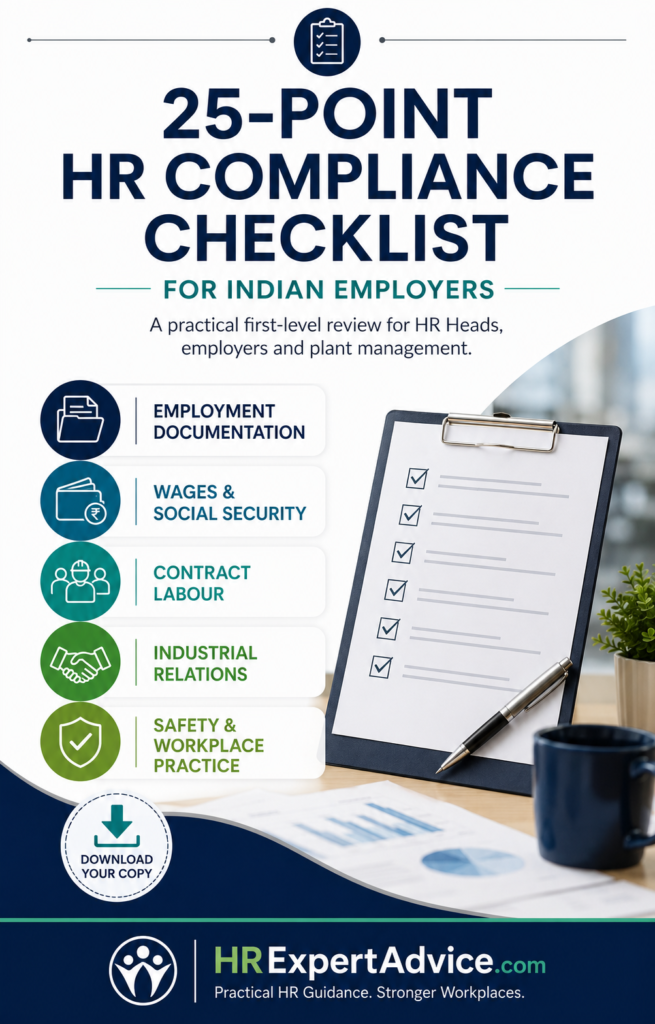
An HR Head or employer can use the following questions as a first-level review:
- Have we identified the labour and employment requirements applicable to every establishment?
- Are registrations and licences current?
- Does every employee have appropriate employment documentation?
- Are employee classifications and roles correctly documented?
- Are applicable minimum wages being paid?
- Has the wage structure been reviewed under the current definition of wages?
- Are wages being paid within applicable timelines?
- Are deductions legally authorized and correctly recorded?
- Are working hours and overtime properly controlled and recorded?
- Are wage slips and prescribed records maintained?
- Are eligible employees properly covered under applicable social-security requirements?
- Do payroll, attendance and social-security records reconcile?
- Is gratuity compliance being monitored?
- Are maternity and other applicable statutory benefits properly administered?
- Have all contract-labour requirements applicable to the establishment been identified?
- Does contractor documentation match the people actually deployed?
- Are contractor wages and social-security records periodically verified?
- Are required grievance/employee-representation mechanisms functioning?
- Are standing orders and disciplinary procedures current where applicable?
- Are safety, health and welfare requirements being followed in actual practice?
- Are accidents, dangerous occurrences and occupational issues reported and documented as required?
- Is POSH compliance current and is the Internal Committee functioning effectively?
- Are employee separations being processed according to the nature of each case?
- Does every recurring compliance requirement have a named owner, due date and evidence?
- Most importantly: Does actual workplace practice match our policies and records?
If HR cannot confidently answer the last question, that is where I would begin the review.
Compliance Is a Management Responsibility

There is a tendency in some organizations to treat compliance as the responsibility of the HR department, the legal department or an external consultant.
They certainly have important roles.
But compliance failures are often created elsewhere.
A supervisor ignores working-hour controls.
Operations allows an unverified contractor worker onto the shop floor.
A department changes an employee’s responsibilities without informing HR.
A contractor takes a shortcut.
A manager delays action on a grievance.
Finance processes something without understanding its employment implication.
Then, when a problem appears, everyone asks:
“Why didn’t HR catch this?”
The better question is:
“What management system allowed this gap to continue?”
HR should coordinate and monitor the compliance framework. Legal advisers should interpret the law. Specialists should guide technical requirements.
But managers who make decisions affecting people must also understand the compliance consequences of those decisions.
That is why I see compliance not as paperwork, but as a form of leadership discipline.
The strongest organizations do not wait for an inspection, complaint, accident or dispute to discover whether they are compliant.
They check themselves first.
And they do something even more important: they check whether what happens every day in the workplace is consistent with what their policies and records claim.
That is where genuine compliance begins.
Need Help Reviewing Your HR Compliance Framework?
Every organization’s compliance requirements are different. They can depend on workforce strength, industry, employee categories, location, use of contract labour and the Central and State provisions applicable to the establishment.
HRExpertAdvice can support organizations in reviewing HR policies, employment documentation, labour-compliance processes and workplace practices, and in identifying gaps before they become larger employee-relations, legal or business problems.
Talk to an HR Expert at HRExpertAdvice.
About the Author
Dr. Ravindran K.A.
HR Leader | Industrial Relations & Compliance Expert | Author | Coach
Dr. Ravindran K.A. is a senior HR professional with nearly three decades of experience across manufacturing organisations and multinational companies. His expertise spans manufacturing HR, industrial relations, labour compliance, employee relations, workplace culture, leadership and organisational development. Throughout his career, he has worked closely with management teams, plant leaders, supervisors and employees in addressing practical people and workplace challenges. His professional approach combines compliance with fairness, discipline with dignity, and business requirements with responsible people management. He also draws valuable lessons from Japanese management practices, particularly in discipline, process consistency, continuous improvement and respect for people.
Official References & Further Reading
1. Ministry of Labour & Employment — Labour Codes
2. Ministry of Labour & Employment — Compliance Handbook for Employers under the Four Labour Codes
Use the official Ministry PDF already verified for the article.
3. Ministry of Labour & Employment — Code on Wages FAQs
Use the official Ministry FAQ.
4. Employees’ Provident Fund Organisation
Official EPFO employer resources
5. India Code — POSH Act, 2013
Disclaimer: This article is intended for general professional information and should not be treated as legal advice for a specific organization or employment matter. Labour-law applicability can vary according to the establishment, jurisdiction, workforce, notifications and applicable Central or State rules. Employers should verify the current requirements applicable to their circumstances.