


EPF Wage Ceiling Increased to ₹25,000: What Employers and HR Professionals Must Do Now
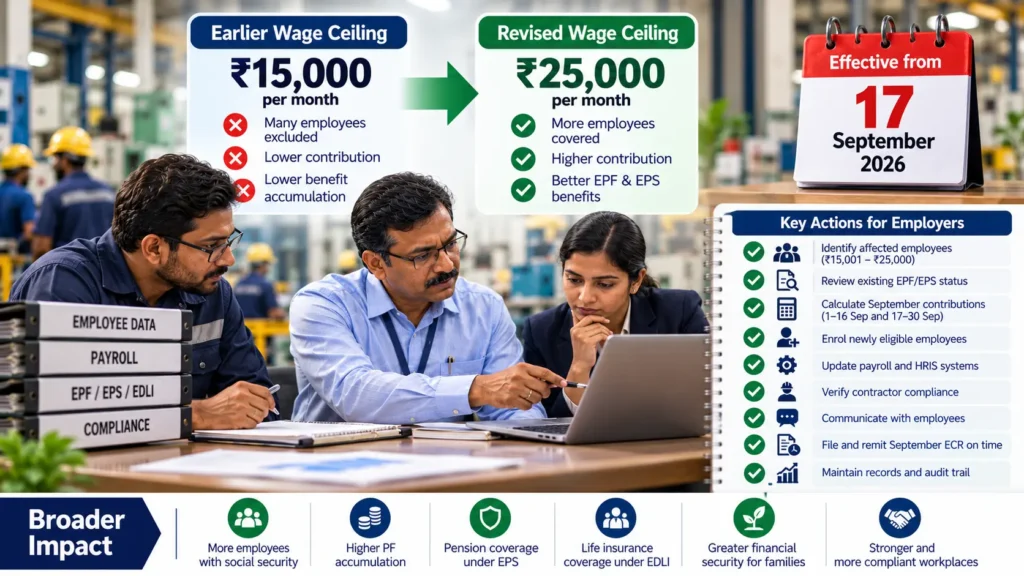
Effective from 17 September 2026
There are some compliance changes that can be handled during the next routine policy review.
This is not one of them.
The statutory EPFO wage ceiling has been revised from ₹15,000 per month to ₹25,000 per month with effect from 17 September 2026. The change extends the mandatory coverage framework to employees who were previously outside it because their relevant wages exceeded the earlier ₹15,000 ceiling, subject to the applicable statutory and scheme conditions.
For HR and payroll teams, however, the real challenge is not simply changing ₹15,000 to ₹25,000 in a payroll field.
The effective date falls in the middle of September.
That means employers need to identify affected employees, review their existing EPF and EPS membership, calculate September contributions correctly, make the required enrolments, communicate with employees and ensure that the September ECR reflects the transition.
In my experience, statutory changes become risky not because organizations deliberately ignore them, but because different functions understand the same change differently.
HR understands coverage.
Payroll understands deduction.
Finance sees the additional cost.
Employees see the impact on take-home salary.
Contractors may wait for instructions.
Management may assume the payroll software will take care of everything.
That is where compliance gaps begin.
For this change, HR should bring all these pieces together.
What exactly the EPF Wage Ceiling has changed?
The statutory wage ceiling has increased:
| Particular | Earlier | Revised |
|---|---|---|
| Statutory wage ceiling | ₹15,000/month | ₹25,000/month |
| Effective date | — | 17 September 2026 |
| Relevant schemes | EPF, EPS and EDLI | Expanded coverage framework |
| Main affected wage band | — | Above ₹15,000 and up to ₹25,000 |
The EPFO FAQ states that the revised ceiling applies to the coverage framework for EPF, EPS and EDLI. It estimates that more than 51 lakh additional employees will come within mandatory EPFO coverage.
That number gives some indication of the scale of the change.
But for an individual employer, the first question should be much simpler:
Who in my organization is affected?
Do not confuse the ₹25,000 ceiling with gross salary
This distinction is particularly important.
The new ₹25,000 figure should not simply be compared with every employee’s gross monthly salary.
According to the EPFO FAQ, the wage ceiling and gross salary are not synonymous. PF contribution continues to be determined with reference to the relevant PF wages and applicable contribution provisions. The FAQ further refers to the definition of wages under Section 2(88) of the Code on Social Security, 2020.
This is one area where payroll teams should avoid making a mechanical system change.
₹25,000 is a statutory wage ceiling. It does not mean that ₹25,000 automatically becomes the PF wage of every employee.
For employees earning below the ceiling, contribution depends on the applicable wages. For employees above it, the applicable statutory and scheme provisions, including any existing higher-wage contribution arrangement, need to be considered.
That distinction matters.
Who should HR identify immediately?
The first exercise should be employee-level mapping.
I would recommend that HR and payroll divide the workforce into clear categories rather than trying to implement one blanket rule.
Pay particular attention to:
- Employees whose relevant PF wages are above ₹15,000 and up to ₹25,000.
- Employees who were previously treated as excluded employees because their wages exceeded the old ceiling.
- Existing EPF members whose contributions were restricted to ₹15,000.
- Existing EPF members who were not EPS members and whose status may now change.
- Employees already contributing on wages above ₹25,000.
- Contract workers falling within the affected wage range.
The EPFO FAQ specifically states that employees already working on 17 September 2026 who were excluded under the earlier ceiling but whose relevant wages are below ₹25,000 are required to be enrolled in EPF, EPS and EDLI from the effective date. The responsibility for enrolment rests with the employer; no separate employee application is required.
This is therefore not something HR should leave to employees to initiate.
September 2026 requires special attention
This is probably the most operationally important part of the change.
The revised ceiling became effective on 17 September 2026.
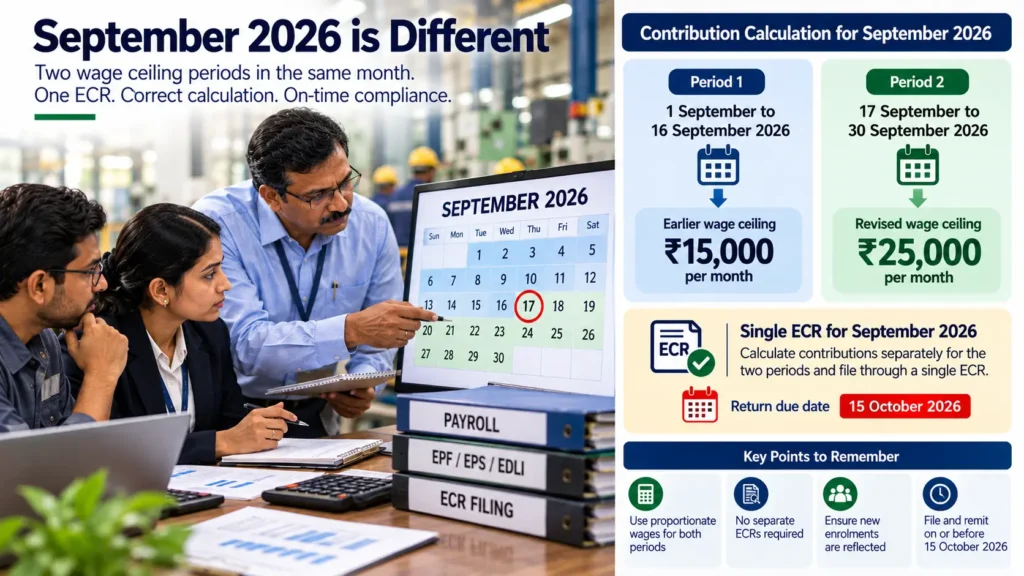
Therefore, September contains two compliance periods:
1 September–16 September 2026: earlier ₹15,000 ceiling applies.
17 September–30 September 2026: revised ₹25,000 ceiling applies.
The EPFO FAQ expressly requires employers to calculate the relevant contributions taking these two periods into account.
Does this mean two ECRs for September?
No.
EPFO’s FAQ says that the September 2026 wage month should be handled through a single ECR, with the contribution appropriately calculated for the two ceiling periods. It states that the September return is ordinarily due by 15 October 2026.
This is an important point for payroll teams.
The calculation may have two periods.
The ECR remains one.
A simple ₹20,000 example
The EPFO FAQ gives several illustrations.
For an employee with PF wages of ₹20,000, the full-month contribution position from October 2026 is illustrated as:
| Contribution | Rate | Amount |
|---|---|---|
| Employee EPF | 12% | ₹2,400 |
| Employer EPS | 8.33% | ₹1,666 |
| Employer EPF | 3.67% | ₹734 |
| Total employee + employer | 24% | ₹4,800 |
The employee continues to contribute 12%, while the employer’s 12% is divided between EPF and EPS as applicable.
The FAQ also illustrates contribution amounts at PF wages of ₹10,000, ₹15,000, ₹20,000 and ₹25,000. At the revised ₹25,000 ceiling, its illustration shows an employee EPF contribution of ₹3,000, employer EPS contribution of ₹2,083 and employer EPF contribution of ₹917, along with the applicable EDLI and administrative charges.
For September itself, however, employers should follow the proportionate transition calculation rather than simply applying the October full-month calculation retrospectively.
What happens to employees who were EPF members but not EPS members?
This deserves separate attention.
An employee earning ₹20,000, for example, may already have been an EPF member while not being an EPS member under the earlier ceiling.
The EPFO FAQ says that with the increase to ₹25,000, such an employee is required to become an EPS member where the revised provisions apply. From October 2026 onwards, in the FAQ’s ₹20,000 illustration, the employer’s 12% contribution is divided between EPS at 8.33% and EPF at 3.67%.
This is why simply changing the contribution ceiling in payroll is not enough.
Membership status must also be reviewed.
What about employees already contributing above ₹25,000?
The revised ceiling should not be interpreted as an instruction to reduce every existing higher-wage contribution to ₹25,000.
EPFO says that employees already contributing on wages above ₹25,000 do not automatically have to reduce their contribution merely because the statutory ceiling has changed. Their existing arrangements continue to be governed by the applicable statutory provisions, scheme provisions and the terms under which the higher-wage contributions were permitted.
This is another reason employee-level mapping is preferable to a blanket payroll instruction.
What happens to employee take-home salary?
For some affected employees, the employee contribution will increase.
The FAQ gives the example of PF wages of ₹20,000. A 12% employee contribution is ₹2,400 per month compared with ₹1,800 where contribution was earlier restricted to ₹15,000.
Employees will notice that difference.
HR should therefore communicate before employees discover the change through their payslip.
The communication should explain both sides:
Immediate impact: the employee’s PF deduction may increase.
Longer-term impact: the employer’s corresponding statutory contribution may also increase, with implications for provident fund accumulation and, where applicable, pension coverage.
Good compliance communication should explain the reason for the change, not merely announce a deduction.
Can the employer simply adjust the increased employer contribution against CTC?
This is an area where management and HR should exercise care.
EPFO’s FAQ states that CTC itself is not the statutory basis for determining PF liability. It also says the employer’s and employee’s contributions are legally distinct and that an employer’s statutory contribution cannot simply be converted into an employee deduction by describing it as part of CTC.
Therefore, organizations should review their compensation structure, employment terms and applicable legal requirements before making any CTC-related adjustment.
A statutory change should not be converted into a salary-structure decision without understanding the consequences.
What if September payroll has already been processed?
This will be a practical concern for many organizations because the notification took effect during the month.
The FAQ provides a specific operational approach. Where an additional employee contribution could not be deducted from September salary for a newly eligible employee, recovery of the employee share may be deferred to the next payroll cycle for take-home salary purposes without prior approval from the Inspector-cum-Facilitator.
But that does not mean the statutory remittance itself can be postponed.
The September ECR must still contain the required employee and employer contribution, and the full statutory remittance must be made within the applicable timeline.
That distinction is important:
Payroll recovery from the employee may be adjusted operationally. Statutory reporting and remittance cannot simply be deferred with it.
Contract labour should not be forgotten
For manufacturing organizations especially, I would add one more action to the internal review.
Do not review only your permanent employee payroll.
Review the contractor workforce as well.
The EPFO FAQ itself includes contractor compliance among the immediate actions employers should review.
Ask each contractor for an updated employee-wise coverage statement.
Then verify it.
Do not merely collect another declaration for the compliance file.
Compare contractor manpower records with gate-entry data, attendance, wage records, UAN information and ECR evidence where applicable.
One principle I repeatedly emphasize in contract-labour management is:
Outsourcing the work does not mean outsourcing the compliance risk.
What should HR do now?
The official FAQ gives employers a useful immediate-action list: identify employees in the ₹15,000–₹25,000 band, identify existing PF members restricted to ₹15,000, determine newly covered employees, review statutory wage components, update September payroll calculations, check EPS eligibility, review contractor compliance, update HR/payroll systems and maintain an audit trail.
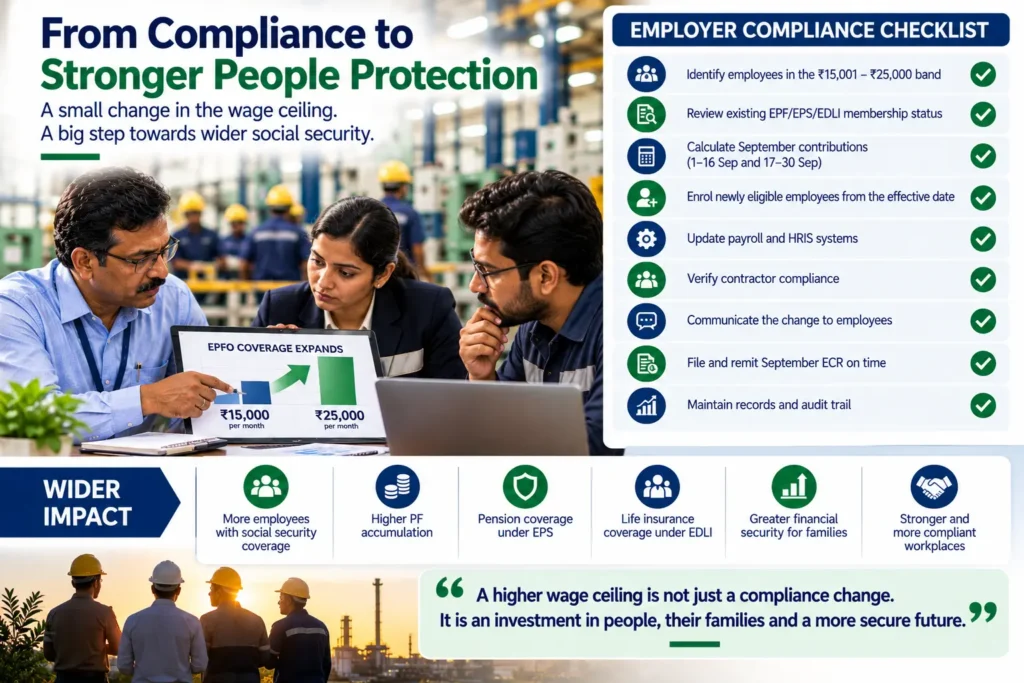
From an HR management perspective, I would convert that into one coordinated implementation plan:
- Identify the affected population employee by employee.
- Classify existing EPF/EPS/EDLI membership correctly.
- Calculate the September transition separately for 1–16 and 17–30 September.
- Enrol newly covered employees from the correct effective date.
- Update payroll and HRIS configurations.
- Verify contractor implementation.
- Communicate the change clearly to employees.
- File and remit the September ECR correctly and on time.
- Reconcile payroll, ECR, employee deductions and employer contributions.
- Document the basis of every material change.
The EPFO FAQ itself summarises the compliance priority in six words:
identify, calculate, enrol, report, remit and reconcile.
That is a useful implementation framework.
A management point that should not be missed
This change is a good example of why compliance cannot remain only with the payroll executive.
Payroll will calculate it.
HR must determine employee status and communicate.
Finance must understand the additional cost.
Contractors must implement it for their affected workforce.
Management must understand the financial and employee-relations implications.
IT or the payroll vendor may need to change system configuration.
And someone must finally reconcile whether all of those actions tell the same story.
A statutory notification may be only a few pages.
Its implementation travels through the entire organization.
That is why compliance is ultimately a management responsibility.
Final takeaway
The most important number in this update is not only ₹25,000.
The most important date is 17 September 2026.
Employers should not wait for October payroll to begin reviewing the change.
Start with the employee population affected by the revised ceiling. Review their existing PF and EPS status. Check September calculations carefully. Verify contractor compliance. Explain the impact to employees. And retain a clear record of how the transition was implemented.
The document may eventually show that the organization is compliant.
The real test is whether payroll, membership, contributions, contractor records and workplace practice all support that conclusion.
Practical Employer Checklist
Before closing the September EPFO compliance cycle, HR should be able to answer yes to these questions:
| Check | Status |
|---|---|
| Employees in the ₹15,000–₹25,000 relevant wage band identified | ☐ |
| Previously excluded employees reviewed | ☐ |
| Existing PF-only / EPS status reviewed | ☐ |
| PF wage components verified | ☐ |
| 1–16 September and 17–30 September calculations checked | ☐ |
| Newly eligible employees enrolled from correct date | ☐ |
| September ECR reviewed before submission | ☐ |
| Employee communication issued | ☐ |
| Contractor compliance verified | ☐ |
| Payroll/ECR/remittance reconciled and audit trail retained | ☐ |
About the Author
Dr. Ravindran K.A.
HR Leader | Industrial Relations & Compliance Expert | Author | Coach
Dr. Ravindran K.A. is a senior HR professional with three+ decades of experience across manufacturing organizations and multinational companies. His expertise spans manufacturing HR, industrial relations, labour compliance, employee relations, workplace culture, leadership and organizational development. Throughout his career, he has worked closely with management teams, plant leaders, supervisors and employees in addressing practical people and workplace challenges. His professional approach combines compliance with fairness, discipline with dignity, and business requirements with responsible people management. He also draws valuable lessons from Japanese management practices, particularly in discipline, process consistency, continuous improvement and respect for people.
Disclaimer
This article is intended for general professional information and HR compliance awareness. It is not a substitute for legal advice. EPF/EPS/EDLI applicability can depend on employee status, wage definition, existing membership, higher-wage contribution arrangements, scheme provisions and other circumstances. Employers should review the applicable notification, schemes, EPFO instructions and subsequent operational clarifications before implementation.
Official References
The principal source for this article is the EPFO “Frequently Asked Questions — Revision of EPFO Statutory Wage Ceiling from ₹15,000 per month to ₹25,000 per month” supplied for this review. It identifies S.O. 5109(E), dated 17 September 2026, and the effective date as 17 September 2026.